
Overview
In 2020, we started a campaign to address declining student enrolment in our Bachelor of Engineering in Industrial and Systems Engineering (ISE). First, we identified a key issue, which is that many pre-university students were unaware of ISE. To address this, we explored multiple solutions and ultimately decided to purchase Google Ads to boost awareness of our programme. Additionally, we invested significant time and effort into improving the clarity, structure, and visual appeal of our website content, making it easier for visitors to recognize and appreciate the unique strengths of the programme.
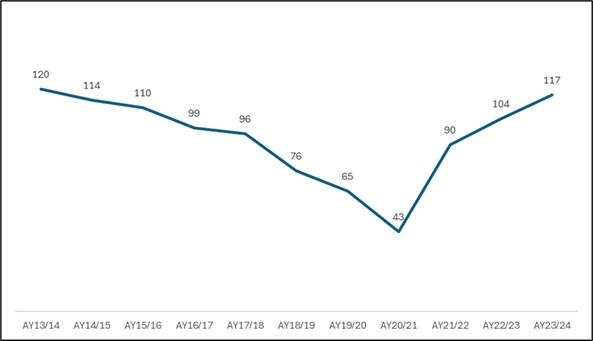
Effective problem-solving hinges on a simple principle: identify the core issues and address them with diligence and focus. By adhering to this principle, we were able to reverse the declining trend and more than double of our enrolment numbers in the subsequent year (see chart above). Next, we discuss in greater depth how the key issues were identified and addressed.
Issue Identification
One issue that was raised is the perception that engineering is less prestigious than other professional degrees such as medicine and law. Given the scale and complexity of changing such perceptions, we believe it is more productive to focus our efforts on other actionable areas. Therefore, there was no need to further investigate or debate the extent or validity of these views.
It was also highlighted that engineering is perceived as academically demanding and having a heavier workload than other majors. While there are steps we could take to address these perceptions, it is worth noting that academically rigorous majors such as computer science continue to attract high student interest. More importantly, while we can implement certain measures, it is unclear whether these efforts would be significant enough to lead to increased student enrolment. Although we do not dismiss this issue entirely, we were reasonably comfortable placing it lower on our list of priorities.
Third, it was suggested that we could enhance the curriculum to better attract prospective students. However, our graduates consistently report very strong employment outcomes, indicating that our current curriculum already meets the needs of multiple employers. Given that student enrolment has struggled despite these strong job metrics, it is not immediately clear that further curriculum enhancements would result in increased enrolment.
In contrast, there was strong optimism that raising awareness of our programme will lead to higher student numbers. Individuals who have never heard of our programme will not apply. However, those who are aware of our graduates’ strong employment outcomes may consider joining us. Logically, increasing awareness should materially increase the number of applications we receive. Furthermore, there are many strategies available to boost awareness. As a result, increasing awareness of our programme became the central theme of our strategy to address declining student enrolment.
Boosting Awareness
After identifying the key issue behind our low student numbers, we explored multiple solutions to address it. These included building a strong social media presence, conducting online webinars and information sessions, organizing in-person workshops and campus tours, engaging with pre-university institutions and participating in their education fairs, and leveraging on our student and alumni networks.
To implement these strategies effectively, it was crucial to have an execution plan that considered our available resources, strengths, and limitations. Guided by the Pareto Principle, we chose to focus on the “vital few” that would yield the greatest impact, rather than spreading our efforts thinly across many less effective activities (i.e., the “trivial many”). While many of the solutions listed above have merit, none appeared particularly effective in generating widespread awareness within our limited timeframe. With the next recruitment cycle approaching, Google Ads emerged as our best option for achieving the desired level of awareness.
Google Ads are paid promotional messages that appear across Google’s digital properties and are designed to direct traffic to our department’s website. To maximize the effectiveness of this approach, we enhanced our website content in conjunction with launching the Google Ads, helping viewers recognize and appreciate the unique strengths of our programme.
Enhancement of Website Content
Guided by the principle of “Less is More,” we focused on conveying key messages clearly and concisely, using simple language and organizing information so users can easily find what they need. An example is how we presented our graduate employment data. Each year, the Ministry of Education conducts a Graduate Employment Survey and publishes the employment rate and salaries of fresh graduates (see image below).
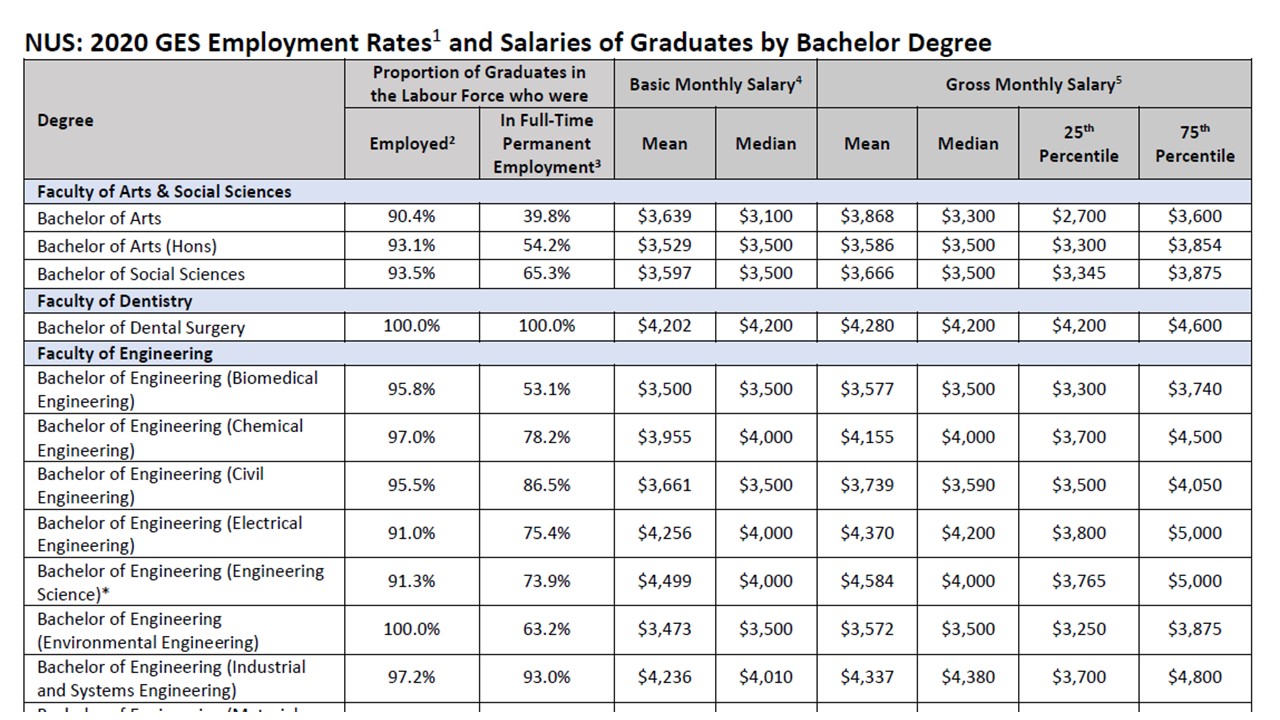
Most degree programmes leave it to prospective students to interpret the Graduate Employment Survey data on their own. However, we found such a laissez-faire approach inadequate, as our graduates’ strong employment outcomes, in both employability and salary, distinguish our programme from many others. The extensive nature of the survey data makes direct comparisons between degree programmes challenging. Therefore, we sought to present the information in a more accessible format.
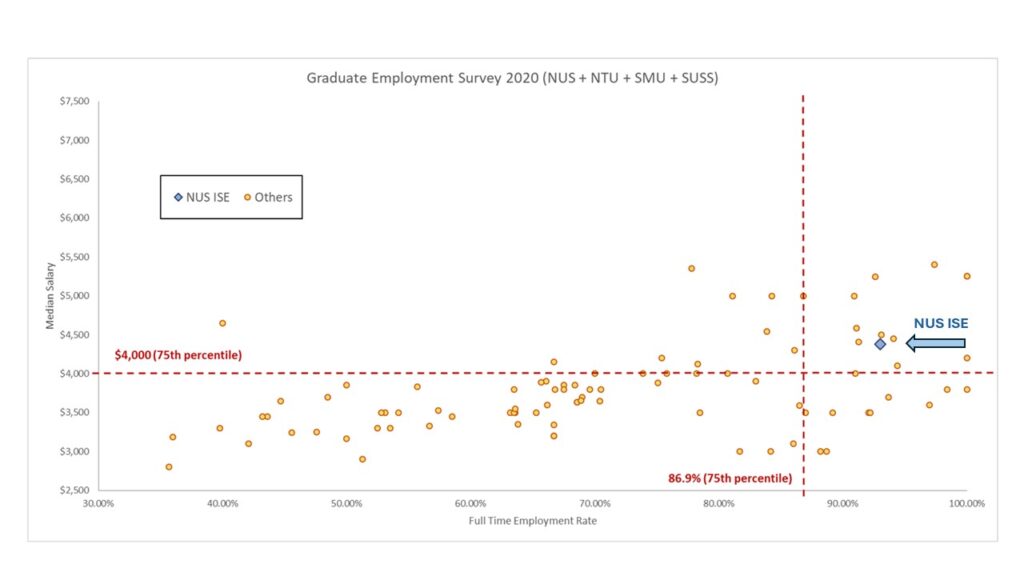
The data falls into two primary categories: employment rates and salaries. Within these, the survey reports two types of employment rate data and six types of salary data. To streamline the comparison, we focused on the full-time employment rate and the median gross monthly salary, and visualized these metrics in a two-dimensional chart (see image below). This provides prospective students with a clear and concise way to compare the career prospects of our graduates with those from other majors.
Throughout the campaign, priority was given to the execution of Google Ads and the improvement of our website content to ensure the successful achievement of our objectives.
Discussion
Throughout our campaign, we prioritized two key issues: increasing awareness and helping prospective students appreciate the unique strengths of our programme. Recognising the critical importance of these objectives fuelled our determination to address them with persistence, even when faced with periods of uncertainty and ambiguity. By maintaining our focus on these priorities, we continually refined our approach and ensured that the programme’s distinctive value was clearly communicated to a wide audience.
Ultimately, effective problem-solving hinges on a simple principle: identify the core issues and address them with diligence and focus. Our success stems from our ability to adhere to this straightforward, yet challenging, principle. Many struggle, not because they lack diligence or intelligence, but because they experience difficulty navigating uncertainty and ambiguity.
We overcame this by welcoming suggestions and engaging in thoughtful deliberation over each idea. This collaborative approach not only broadened our perspectives and ensured that blind spots were addressed, but also increased our confidence that the best possible options were considered, allowing us to continuously progress without second guessing or overanalysing.
Interested readers are referred to my following article: Solving Complex Problems: Diligence, Focus and Embracing the Unknown.