
Critical thinking and good judgment, which are essential for tackling complex challenges that AI alone cannot solve, will remain highly valued in the workplace of the future. Complex problems are not resolved quickly or easily. Sustained effort and persistence are necessary to work through setbacks, refine approaches, and continue seeking solutions despite difficulties.
Many people struggle with real-world problems not from a lack of effort, but because they have difficulty coping with uncertainty and ambiguity. Often, the struggle with uncertainty and ambiguity stems from outcome bias: the tendency to evaluate decisions based solely on their results rather than the quality of the reasoning behind them. This approach is flawed, as fortunate outcomes can sometimes arise from poor decisions, such as a compulsive gambler who wins big despite reckless choices.
Recognizing that setbacks can stem from the nature of the problem, rather than from flawed decisions or incompetence, is crucial. If individuals believe that only successful outcomes are valued or that mistakes are a sign of failure, they become reluctant to explore, experiment, or take risks. This reluctance stifles creativity, innovation, and progress, dooming the entire problem-solving effort before it begins.
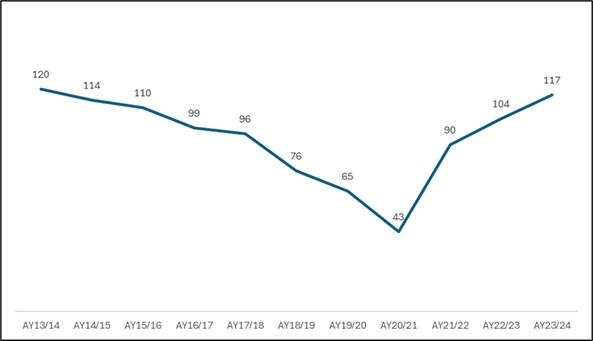
In 2021, we successfully reversed our declining student enrolment numbers (see chart above) by following a simple principle: identify the core issues and address them with diligence and focus. Details are discussed in my article: Reverse Declining Trend in Student Enrolment.
Reflecting on that experience, I identify three principles to develop well-grounded confidence when operating under uncertainty and ambiguity. In a nutshell, recognize that things can still go wrong even if we did everything right, be ready to defend one’s decision with the confidence that the decision has already been “vetted” by others. In addition, I highlight another three principles that help maintain focus and optimize efforts towards delivering meaningful results.
| Develop well-grounded confidence | Maintain focus and avoid wasted effort |
|---|---|
| Acknowledge the role of luck: Recognize that poor outcomes may simply result from chance, not necessarily from incompetence or poor judgment. | Prioritize key issues: Addressing a few critical issues can often be sufficient to bring about significant results. |
| Defend decisions with sound reasoning: Always be able to explain decisions with clear, logical, and understandable reasoning. | Control the controllables: Focus efforts on what we can affect. Dwelling on factors beyond our control yields little benefit. |
| Collaborate effectively: Working with others not only improves the quality of solutions but also enhances confidence in those solutions. | Move forward with “good enough”: Excessive information gathering and analysis leads to waste, frustration, distraction, and missed opportunities. |
Collectively, these six principles empower individuals to address challenges with diligence and focus, fostering the resilience required to overcome setbacks and continually refine strategies, even amid ambiguity and uncertainty. This is discussed in greater detail in my article: Solving Complex Problems: Diligence, Focus and Embracing the Unknown.
I am acutely aware that applying these principles in real-world situations can be challenging. For instance, attributing a negative outcome to chance rather than poor decision-making may be perceived as making excuses, even when the outcome is genuinely the result of misfortune. For a detailed list of practical challenges and suggestions on how to address them, please refer to our Q&A section.: Solving Complex Problems (Questions and Answers).